what radiographic procedure employs high-frequency sound waves to produce an image?
- Description
- Uses
- Benefits/Risks
- Data for Patients including Expectant Mothers
- Information for Wellness Care Providers
- Information for Practices Conducting Ultrasound Imaging
- Information for Manufacture
- Reporting Problems to the FDA
- Other Resources
Description
Ultrasound imaging (sonography) uses high-frequency sound waves to view inside the body. Because ultrasound images are captured in real-time, they can also prove motility of the body's internal organs equally well as blood flowing through the blood vessels. Different Ten-ray imaging, there is no ionizing radiation exposure associated with ultrasound imaging.
In an ultrasound exam, a transducer (probe) is placed directly on the pare or inside a body opening. A thin layer of gel is practical to the skin so that the ultrasound waves are transmitted from the transducer through the gel into the trunk.
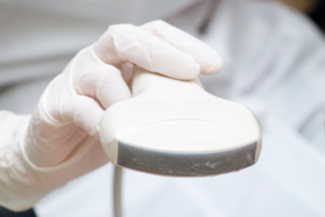
Moving-picture show of a transducer (probe) used during an ultrasound exam.
The ultrasound prototype is produced based on the reflection of the waves off of the body structures. The strength (amplitude) of the audio bespeak and the time it takes for the moving ridge to travel through the body provide the information necessary to produce an image.

Uses
Ultrasound imaging is a medical tool that can assist a physician evaluate, diagnose and care for medical conditions. Common ultrasound imaging procedures include:
- Intestinal ultrasound (to visualize intestinal tissues and organs)
- Bone sonometry (to appraise os fragility)
- Breast ultrasound (to visualize breast tissue)
- Doppler fetal heart rate monitors (to listen to the fetal heart shell)
- Doppler ultrasound (to visualize blood menses through a claret vessel, organs, or other structures)
- Echocardiogram (to view the centre)
- Fetal ultrasound (to view the fetus in pregnancy)
- Ultrasound-guided biopsies (to collect a sample of tissue)
- Ophthalmic ultrasound (to visualize ocular structures
- Ultrasound-guided needle placement (in blood vessels or other tissues of interest)
Benefits/Risks
Ultrasound imaging has been used for over twenty years and has an fantabulous safety record. Information technology is based on not-ionizing radiation, so information technology does not have the same risks every bit X-rays or other types of imaging systems that use ionizing radiation.
Although ultrasound imaging is generally considered safety when used prudently by appropriately trained health care providers, ultrasound energy has the potential to produce biological effects on the body. Ultrasound waves tin estrus the tissues slightly. In some cases, it tin can also produce small pockets of gas in body fluids or tissues (cavitation). The long-term consequences of these effects are however unknown. Because of the particular concern for effects on the fetus, organizations such as the American Found of Ultrasound in Medicine --]) accept advocated prudent utilise of ultrasound imaging in pregnancy. Furthermore, the use of ultrasound solely for non-medical purposes such as obtaining fetal 'keepsake' videos has been discouraged. Emblem images or videos are reasonable if they are produced during a medically-indicated exam, and if no boosted exposure is required.
accept advocated prudent utilise of ultrasound imaging in pregnancy. Furthermore, the use of ultrasound solely for non-medical purposes such as obtaining fetal 'keepsake' videos has been discouraged. Emblem images or videos are reasonable if they are produced during a medically-indicated exam, and if no boosted exposure is required.
Information for Patients including Expectant Mothers
For all medical imaging procedures, the FDA recommends that patients talk to their health care provider to empathize the reason for the examination, the medical information that will be obtained, the potential risks, and how the results volition exist used to manage the medical status or pregnancy. Because ultrasound is non based on ionizing radiations, it is particularly useful for women of kid-bearing age when CT or other imaging methods would otherwise upshot in exposure to radiations.
Expectant Mothers

Ultrasound is the nigh widely used medical imaging method for viewing the fetus during pregnancy. Routine examinations are performed to appraise and monitor the health status of the fetus and mother. Ultrasound examinations provide parents with a valuable opportunity to view and hear the heartbeat of the fetus, bond with the unborn babe, and capture images to share with family and friends.
In fetal ultrasound, 3-dimensional (3D) ultrasound allows the visualization of some facial features and maybe other parts such as fingers and toes of the fetus. Four-dimensional (4D) ultrasound is 3D ultrasound in motion. While ultrasound is by and large considered to be prophylactic with very depression risks, the risks may increment with unnecessary prolonged exposure to ultrasound energy, or when untrained users operate the device.
Expectant mothers should likewise be aware of concerns with purchasing over-the-counter fetal heartbeat monitoring systems (also called doptones). These devices should only be used by trained wellness care providers when medically necessary. Use of these devices by untrained persons could expose the fetus to prolonged and unsafe energy levels, or could provide information that is interpreted incorrectly past the user.
Additional resources on ultrasound imaging:
Information for Health Intendance Providers
As part of FDA's Initiative To Reduce Unnecessary Radiation Exposure From Medical Imaging, FDA has recommended that health care providers consider examinations that use little or no ionizing radiation exposure, such as ultrasound or MRI, if medically appropriate. Ultrasound imaging does introduce energy into the body, and laboratory studies accept shown that diagnostic levels of ultrasound can produce physical furnishings in tissue, such every bit pressure level oscillations with subsequent mechanical effects and rise in temperature. Therefore, FDA recommends that health care providers consider means to minimize exposure while maintaining diagnostic quality when using ultrasound. As with all other imaging modalities, the principles of As Low As Reasonably Achievable (ALARA) should be skilful by health care providers.
Individual states regulate the use of diagnostic ultrasound through recommendations and requirements for personnel qualifications, quality assurance and quality control programs and facility accreditation.
Information for Facilities Conducting Ultrasound Imaging
Ultrasound practices should consider site and staff participation in voluntary accreditation and certification programs that address both prophylactic and effectiveness of the device following the principles of As Low As Reasonably Doable (ALARA), such as those offered past the American Institute of Ultrasound in Medicine and the American Registry of Diagnostic Medical Sonographers.
Any wellness care facility employing ultrasound should comport regular quality control tests to ensure that equipment is functioning properly.
Information for Industry: Ultrasound Manufacturers
Manufacturers of electronic radiations emitting products sold in the United states of america are responsible for compliance with the Federal Nutrient, Drug and Corrective Act (FFDCA), Chapter 5, Subchapter C - Electronic Product Radiation Control.
Manufacturers of ultrasound imaging products are responsible for compliance with all applicable requirements of Title 21 Code of Federal Regulations (Subchapter J, Radiological Health) Parts 1000 through 1005:
1000 - General
1002 - Records and Reports
1003 - Notification of defects or failure to comply
1004 - Repurchase, repairs, or replacement of electronic products
1005 - Importation of electronic products
There are no federal radiation rubber performance standards for diagnostic ultrasound.
Because they are medical devices, ultrasound imaging equipment must too comply with the medical device regulations. For more data, see Getting to Market with a Medical Device.
Manufacture Guidance - Documents of Interest
- Guidance for Industry and FDA Staff - Data for Manufacturers Seeking Marketing Clearance of Diagnostic Ultrasound Systems and Transducers (PDF Version) (PDF - 474KB)
- Announcement for Imported Electronic Products Subject to Radiation Command Standards (PDF - 399KB)
- Ultrasound Letter to Industry (PDF 41KB)
- Variance Application Process
Reporting Problems to FDA
Prompt reporting of adverse events tin assistance the FDA place and better understand the risks associated with the product. Nosotros encourage health care providers and patients who doubtable a problem with a medical imaging device to file a voluntary report through MedWatch, the FDA Safety Information and Adverse Issue Reporting Programme.
Health care personnel employed past facilities that are subject to FDA'southward user facility reporting requirements should follow the reporting procedures established past their facilities.
Medical device manufacturers, distributors, importers, and device user facilities (which include many wellness care facilities) must comply with the Medical Device Reporting (MDR) Regulations of 21 CFR Part 803.
In addition to following the general recommendations (for manufacturers, facilities, and any member of the public) for reporting issues for adverse events associated with ultrasound imaging, the following information should be included in reports, if bachelor:
- the protocol beingness followed during the event;
- sample images, if bachelor;
- the weather condition of performance, including technical parameters such as:
- mode of operation
- clinical application
- Thermal Index (TI) and Mechanical Index (MI)
- elapsing of scan, if known
Other Resources
- Does the Product Emit Radiation?
- Getting a Radiation Emitting Product to Market
- Records and Reporting (Radiations-Emitting Products)
- Importing and Exporting Electronic Products
brownburpecto1977.blogspot.com
Source: https://www.fda.gov/radiation-emitting-products/medical-imaging/ultrasound-imaging
0 Response to "what radiographic procedure employs high-frequency sound waves to produce an image?"
Postar um comentário